
Switching seedbox providers is a bigger decision than it looks. Your seedbox is where your torrents live, where your media apps run, and often where your streaming and remote-download workflows are anchored. So when people go looking for an alternative to an established provider like DediSeedbox — a company whose name suggests a focus on dedicated seedboxes — it is usually for concrete reasons: they want a cheaper entry point, they are not sure they actually need a dedicated machine, they want more one-click apps, or they want managed hosting that heals itself instead of leaving them to babysit a box. This guide is criteria-led. Rather than making claims about any specific competitor, it gives you the checklist we apply in every review on this site, and then shows honestly how our disclosed picks measure up against it.
If you are new to the category, this beginner’s guide to seedboxes is a good primer before you compare providers.
Shared vs dedicated: most people don’t need dedicated
The single most useful question to settle first is whether you need a dedicated seedbox at all. A dedicated server means the entire physical machine — CPU, RAM, disk, and network port — belongs to you. That is genuinely valuable if you are seeding terabytes across hundreds of torrents, running heavy transcoding, or you simply want guaranteed, uncontended resources. It is also more expensive, and for the majority of users it is more than they will ever use.
A shared seedbox puts several users on one well-provisioned server with resource limits in place. For the common case — a few dozen active torrents, a media library, remote downloading, the occasional stream — a good shared plan is fast, cheap, and completely sufficient. Between the two sits the dedicated-IP VPS: your own slice of a machine with a dedicated IP address, which is a useful middle ground when you want isolation without paying for a whole server.
The honest takeaway: don’t let a provider’s branding push you into a tier you don’t need. The right alternative is one that offers the full range so you can match the plan to your actual usage. If you are weighing the managed-vs-do-it-yourself dimension too, our seedbox vs VPS comparison breaks down when a managed seedbox beats renting a bare VPS.
What to look for in a seedbox alternative
Use this checklist when evaluating any provider, DediSeedbox or otherwise:
- A range from shared to dedicated. Can you start small and scale up — or down — without changing providers? A host that only sells one tier forces you to over- or under-buy.
- Transparent pricing. Clear monthly prices, clear storage, clear bandwidth. Watch for “unlimited” claims that hide throttling, and for setup fees.
- Storage and bandwidth that match your habits. Match disk to your library size and bandwidth to how much you actually move each month.
- App breadth. One-click installs for the tools you use — the *arr suite, Plex or Jellyfin, download clients, indexers — save hours versus manual setup.
- Managed vs unmanaged. Do you want to maintain the box yourself, or should the provider handle updates, restarts, and failures?
- Reliability and self-healing. When an app crashes at 3am, does it come back automatically, or does it wait for a support ticket?
- Network and privacy features. VPN support, dedicated IPs, and sensible port handling matter for both speed and privacy.
- Real support. Responsive, knowledgeable humans — not just a knowledge base.
No single provider wins every line item. The point is to weight the criteria by what you personally care about, then compare honestly. Our Best Seedbox 2026 comparison applies the same framework across the whole market.
How our premium pick, EvoSeedbox, measures up
Here is where EvoSeedbox lands against that checklist, in concrete terms.
Full range from shared to dedicated. This is the core of the pitch. You do not have to overpay for a dedicated machine if you don’t need one:
- Shared plans from $5/mo starting at 150GB — a genuine low-cost entry point for people who just want a fast, reliable box.
- Dedicated-IP VPS plans from $15 to $40 with 400GB up to 1.6TB — the middle ground, with your own IP and isolated resources.
- Full dedicated servers from $30 to $80, ranging from a 1TB machine in France up to an 8TB machine in the Netherlands with 100TB of bandwidth — for heavy seeders who want the whole box.
Apps and automation. Over 50 one-click apps cover the common media and download stacks, so you spend time using your seedbox rather than configuring it.
Managed and self-healing. Every plan is fully managed. App Doctor, its self-healing system, detects and repairs failed apps automatically across the fleet, so a crashed service typically recovers on its own instead of waiting on a ticket.
Reliability at scale. EvoSeedbox runs across 46 servers, which gives it room to place customers well and keep performance consistent.
Downloads and privacy. Unlimited downloads on every plan, with WireGuard and OpenVPN support for private, encrypted transfers.
You can see current tiers and storage on the pricing page.
An honest note
EvoSeedbox is not automatically the right answer for everyone. If you already run an established provider like DediSeedbox and it is serving you well, there may be no reason to move — familiarity and a working setup have real value. Offerings also change over time, so as of 2026 you should check any provider’s current plans, pricing, and specs directly before deciding; don’t rely on a snapshot. Where EvoSeedbox tends to win is breadth of choice — real shared, VPS, and dedicated tiers under one roof — combined with managed self-healing so you are not the on-call engineer for your own seedbox. If those are the things you value, it is worth a look. If you specifically need a single-tenant dedicated machine and nothing else, compare the full-dedicated tiers head to head on the specs that matter to you.
How to tell whether you actually saturate a shared box
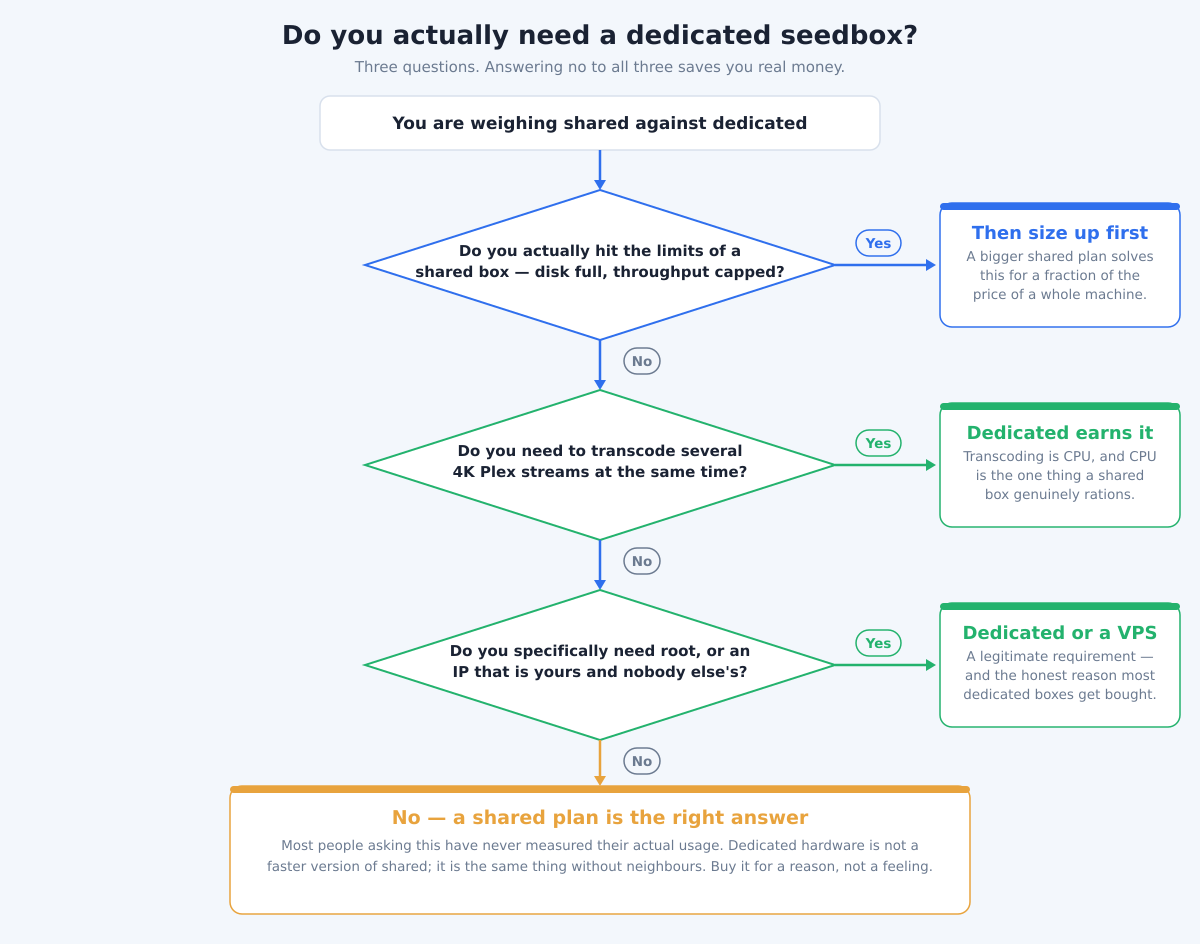
“Most people don’t need dedicated” is easy to say and unsatisfying to hear, because it does not tell you which group you are in. These are the four measurements that answer it, and all four take minutes.
- Check whether your disk is genuinely full, or just untidy. Look at actual usage rather than your impression of it. Storage pressure is the most common reason people reach for dedicated, and it is the one a larger shared plan solves for a fraction of the price. Prune what you have finished seeding first — you may find the problem evaporates.
- Find out whether your throughput is capped or simply unremarkable. Run a large well-seeded torrent and watch the plateau. If it sits at a hard, repeatable ceiling, something is limiting you. If it varies with the swarm, the swarm is the limit and a dedicated machine will change nothing at all — you cannot buy your way past peers who are not there.
- Count your simultaneous Plex transcodes, honestly. This is the one that genuinely justifies dedicated hardware, because transcoding is CPU and CPU is the resource a shared box actually rations. Two people watching Direct Play is not a transcoding workload; three 4K streams being converted at once is. EvoSeedbox reports that the overwhelming majority of the Plex servers running on its fleet are comfortable on shared plans — the demanding minority is real, but it is a minority.
- Ask whether you need root, or just want it. Wanting to run something unusual, hold an IP that is yours alone, or configure the machine yourself are all legitimate reasons to buy dedicated — and they are honest ones. They are simply different reasons from performance, and worth separating, because a shared plan will never satisfy them however large it gets.
If all four come back negative, the upgrade you want is a bigger shared plan, not a different class of machine. Dedicated hardware is not a faster version of shared hosting — it is the same hardware without neighbours, and paying for solitude you do not need is the most common overspend in this market.
Frequently Asked Questions
Do I actually need a dedicated seedbox?
Most people don’t. If you run a moderate number of torrents, a media library, and some remote downloading, a good shared plan or a dedicated-IP VPS is plenty. Dedicated servers make sense when you seed terabytes, need guaranteed uncontended resources, or run heavy transcoding. Start with your real usage, not the label on the plan.
What’s the difference between shared, VPS, and dedicated at EvoSeedbox?
Shared plans (from $5/mo, 150GB) put you on a well-managed server with resource limits — cheapest and simplest. Dedicated-IP VPS plans ($15–$40, 400GB–1.6TB) give you your own IP and isolated resources. Full dedicated servers ($30–$80, 1TB to 8TB) hand you the entire machine, up to 100TB of bandwidth on the largest tier.
How do I switch seedbox providers without losing my setup?
Plan the move before you cancel anything. Note your active torrents and app configurations, transfer or re-add your data, and reinstall your apps on the new box — one-click installers make this quick. Keep the old account active until the new one is fully working, then cancel. A managed host’s support team can usually walk you through the migration.
Is a managed seedbox better than running my own VPS?
It depends on how much maintenance you want to do. A managed seedbox handles updates, restarts, and failures for you — with App Doctor, many issues self-heal automatically. A bare VPS gives you more control but makes you responsible for everything. See our seedbox vs VPS comparison for a full breakdown.
What should I compare when evaluating an alternative?
Look at whether the provider offers a range from shared to dedicated, transparent pricing, storage and bandwidth that fit your habits, app breadth, managed vs unmanaged hosting, reliability and self-healing, VPN and privacy features, and real human support. Weight those by what you personally care about rather than chasing a single headline number.
Ready to find the right fit instead of overpaying for a tier you don’t need? Compare the market in our Best Seedbox 2026 guide, or explore our premium pick’s full range — shared from $5/mo, dedicated-IP VPS, and full dedicated servers — on the EvoSeedbox pricing page.
Notes from readers